
Deck Heights for a Double-Decked Layout?
 Friday, February 24, 2012 at 9:57PM
 My layout plan is double-decked to produce plenty of mainline run (over 7 scale miles). My belief is that that the added cost, time, and effort, of building two decks instead of only one, will pay off by providing much more enjoyable operations.
Ideal layout height is about chest-height for N scale, or ~52” above the floor, give or take an inch or two. Single deck linear layouts with tracks at 52” look great, and are great to operate as well. Operators have a good view of the rolling stock, scenery and backdrop, uncoupling cars is easy and comfortable, and crews are close enough to the action to enjoy the detail in all parts of the scene.
The N scale hopper car in the pic below is at 52 inches above the floor on one of my FremoN modules. With the viewer’s eye level at about 65 inches, the sides and top of the car are easy to view. Reaching over to uncouple cars at 52 inches above the floor is a snap.
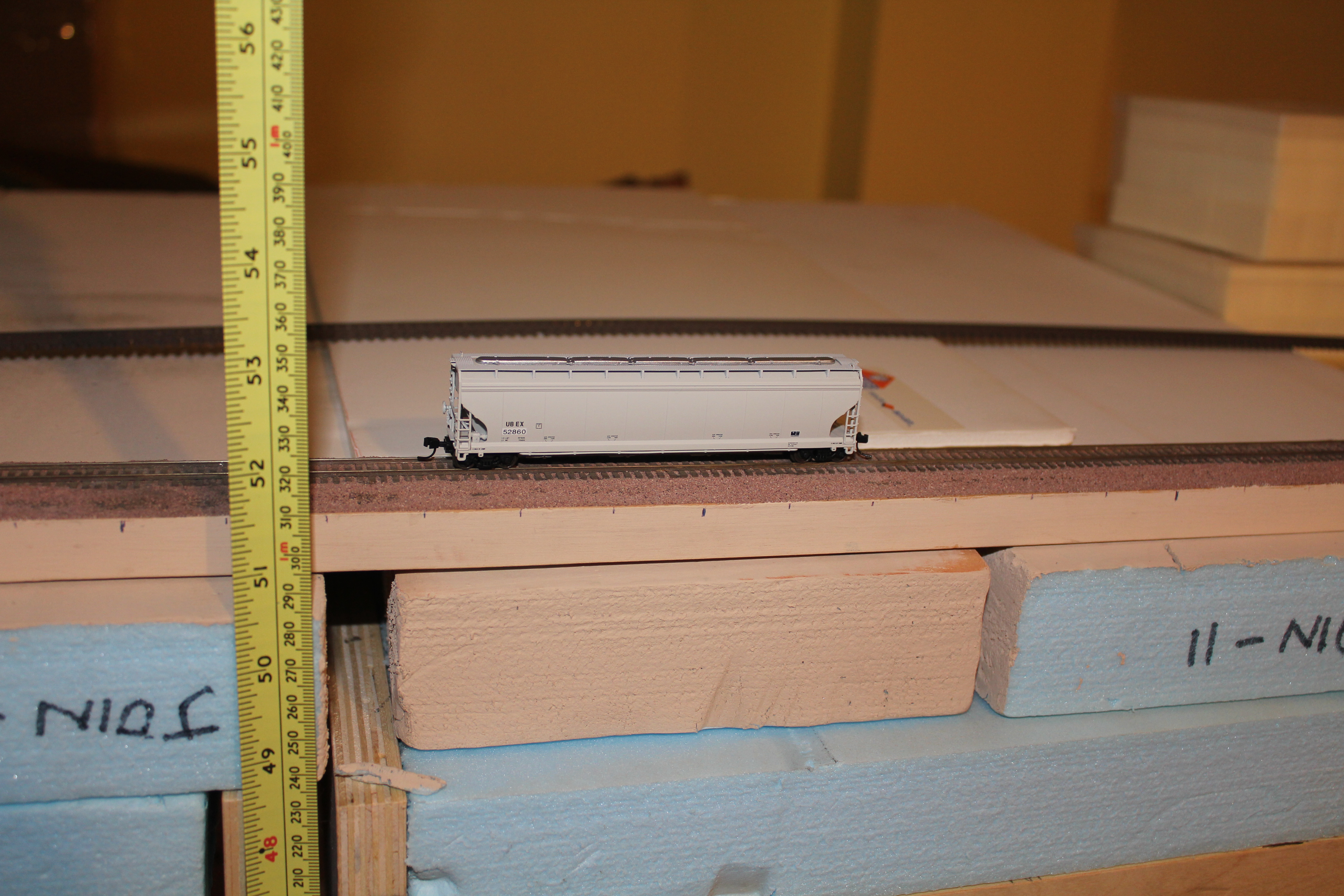
Ya can’t have it both ways!
However, with double-deck layouts, both decks can’t be at the ideal height of 52 inches. In fact, if either deck is built at the ideal height, then the other deck will be too low or too high. When that happens, trains on that deck are hard to view, and could be awkward to operate. And we don’t want that!
Figuring out the best height for each deck, before beginning construction, is critical! Trains and scenery that can’t be seen, might as well not have been built in the first place! If operators have to stoop and reach uncomfortably while switching, enjoyment while will be reduced.
Getting the heights right
The goal is to determine heights for the upper and lower deck that maximize the enjoyment of operating on each deck.
The analysis of ideal deck heights is mostly about compromise and tradeoffs. You give up something, to get more of what you want. In my case, I want good visibility and enjoyable operations on both decks and I’m prepared to sacrifice less important things such as deck width to get them.
Key Questions
In preparing for construction, these are the questions I want to answer:
- How high should each deck be?
- How thick should the upper deck be at it’s fascia
- How wide should either decks be (aisle to backdrop)
[I’m interested in your answers to these questions, feel free to post a comment at the link below this article]
Sight Lines for Each Deck
In order to figure out the correct numbers, I need to understand what can be seen at various deck heights.
I am average height at 5’ 11” tall. This puts my eye level at about 65” from the floor when looking at a slight downward angle toward the layout. I’ll be designing the deck heights for an eye level of 65” then. There are certainly taller and shorter operators, and I’ll factor that in where I can.
When operating on either of the decks, I want the following for the typical operator:
- Good views of the entire deck to the backdrop, and at least half of the backdrop.
- When looking at the layout, the lighting on the underside of the upper deck does not shine into operators’ eyes during normal operations
This means…
- There needs to be enough separation between the decks so that the lower deck and backdrop can be seen below the upper deck
- The lower edge of the upper deck fascia needs to be below eye level (<65”) to prevent unwanted glare from the lower deck lighting
Walkaround Control Considerations
My layout has a linear design and will be operated via walkaround control. Operators move along the aisle with their train, follow signals, meet other train traffic, switch cars, pass other operators etc.. This means the decks need to be positioned relative to a standing operator.
- No Stooping needed. I’ve operated on layouts where you have to stoop to see your train, and reach in to switch cars - it’s like switching in a cupboard! What this means for deck heights is that the decks need to be high enough so operators don’t have to stoop, and high enough that the top deck does not obscure the lower deck.
- Steps and footstools not required. Standing on a step stool to switch the upper deck subtracts from the fun of operating, and can be dangerous for some operators, so that’s out too. The top deck needs to be as high as possible but it’s lower edge must also stay below eye level.
It depends where you stand
What can be seen on a double decked layout depends a lot on how far back from the layout the operator is standing. I think it is important that the operator can comfortably uncouple a car at the rear of both decks, with good visibility to the rolling stock and the surrounding scenery.
For my analysis, I have assumed that the operator’s eye position is typically 9-10” away from the outside edge of the lower deck. This is a comfortable distance to be able to reach and uncouple cars at the rear of either deck.
Standing a 9-10 inches from the deck is not a problem for the upper deck. The operator can see and reach to the back of the upper deck, provided the upper deck is below eye level
However, if the upper deck is too low, the operator will be able to reach, but not easily see, cars to be uncoupled at the back of the lower deck.
So the takeaway is the upper deck must be as high as possible, but below eye level, in order for switching on both decks to be comfortable for the operator.
Upper Deck Overhang/Underhang
Visibility of the lower deck depends a lot on whether the upper deck
- overhangs the lower deck
- is the same depth as the lower deck, or,
- is shallower than the lower deck.
Not surprisingly, the wider the upper deck becomes, less of the lower deck and lower deck backdrop will be visible.
One solution is to make the upper deck narrower than the lower deck (underhang), but this is not always possible, depending on the track plan.
In addition, the lighting for the lower deck will be in the upper deck, and it is better if that lighting is above the front edge of the lower deck - i.e. for best lower deck lighting, the upper deck should be about the same width as the lower deck where possible. A little underhang is acceptable from a lighting standpoint and pays dividends in the form of better visibility of the lower deck.
Very Narrow Decks (12” or less)
Double deck layouts have fewer visibility issues when the width of the upper deck is narrow compared to the deck separation. This is true where the decks are the same width or even where the upper deck overhangs the lower deck slightly.
Narrow decks for N scale work very well. In N scale, even narrow decks can hold several tracks and some limited scenery or structures.
Very narrow decks also have benefits during construction. Less material is required leading to lower cost and less construction time than for wider decks.
The Stockton Sub upper deck is generally less than 10” wide. If the deck separation is greater by a decent margin than the 10”, the lower deck will be too low for the upper deck to obscure it significantly.
Doing the math
To get started on figuring some rough numbers, I put together a spreadsheet model to calculate how much of each deck could be seen depending on the following:
- Viewer’s eye level
- Distance away from the lower deck front edge
- Heights of each deck
- Thickness of upper deck at the fascia
- Width of each deck
Here’s a screen shot of the excel model:
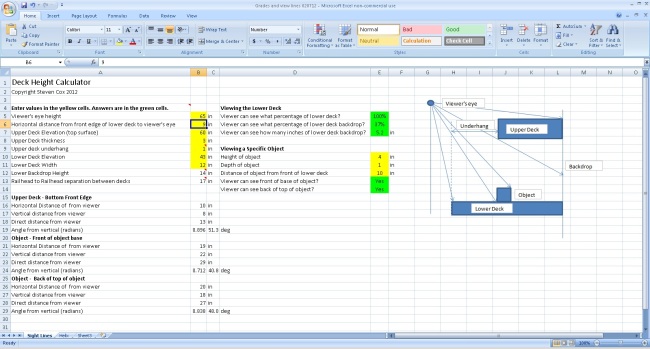
There are a million combinations of these numbers, but messing around with the model quickly confirmed my thinking about what matters:
- How close is the operator to the layout - Standing closer makes it easier to see the top deck and harder to see the lower deck. The range of standing distances is limited though, because, our arms are only so long, and switching N scale cars more than 18 inches away is a pain. 8-10” is a good assumption for distance the operator will be standing from the layout while switching.
- Keep the upper deck as close to eye level as you can. Raising the upper deck causes it to block a lot less of the lower deck. If the upper deck is above eye level, the operator will require a stool to stand on. If the deck is at eye level, switching is difficult because the viewer can’t easily see which way turnouts are thrown. 4-5 inches below eye level affords good views of the upper deck and particularly the track.
- Lowering the lower deck. Lowering the lower deck means more is visible below the upper deck, but it makes it feel like you are looking down on the trains from altitude. As the lower deck drops more and more below chest height uncoupling can be more uncomfortable as the operator is uncoupling with more fully extended arms.
- Increase the separation of the decks. All things being equal, moving the decks further apart really helps with visibility. Increased separation between decks can also help the scenery feel more expansive on the lower deck. The extra headroom is a boon when maintaining track or working on scenery. Increased separation is not for free, it increases run time in the helix between the decks.
- Avoid having the upper deck overhang the lower deck. This one seems obvious, but having the upper deck wider than the lower deck really crushes what you can see on the lower deck. In fact, going with a little underhang pays off a lot in terms of increased visibility of the lower deck.
- Keep the decks narrow. The way the math works out, the further back on the lower deck you need to see, the more the upper deck interferes with that view. On the plus side, keeping the decks narrow (think bookshelves for novels) makes height and separation less important.
- Keep the upper deck thin at the fascia. The view of the lower deck is blocked by the lower front edge of the upper deck. The thicker the upper deck is at the fascia, the more the lower front edge of the upper deck blocks the lower deck. Keep that edge higher (raise the upper deck, and/or keep the upper deck thinner) and more of the lower deck can be seen.
If you would like a copy of the excel deck height model, please email me and I’ll be happy to send you a copy.
The excel model was instructive. After a little playing with the numbers, I was ready to test out to see if the numbers from the model worked in practice.
The model told me to try 58-63 inches for the upper deck, try 40-45 inches for the lower deck and 3” for the upper deck fascia thickness. It also told me that lower decks up to 14 inches wide could be okay, though less than 12 inches would be better.
Mock it up
The spreadsheet gave me a good starting point for the mock up. I used some storage boxes and some foam, track and cars to mess around with different heights to see what deck heights would work. Bookshelves are also a good place to try out your assumptions on deck height.
Here’s a mockup with a 3 inch thick upper deck, upper deck at 60 inches and lower deck at 43 inches.
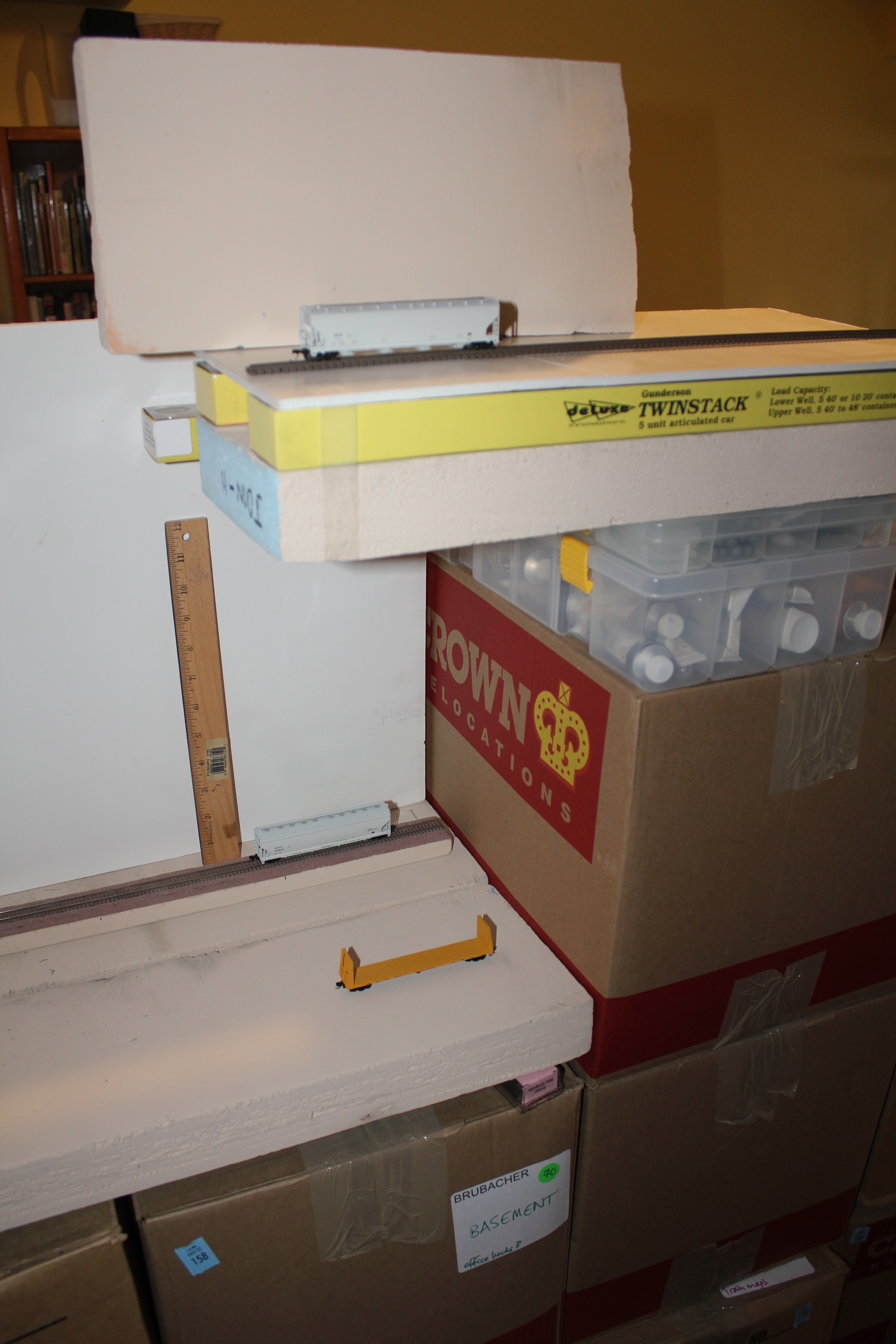
The mocked up lower deck is 12 inches wide. This following shot is taken at my eye level and shows what I can see when standing about 9 inches from the lower deck. About fivr inches of the ruler at the backdrop is visible.
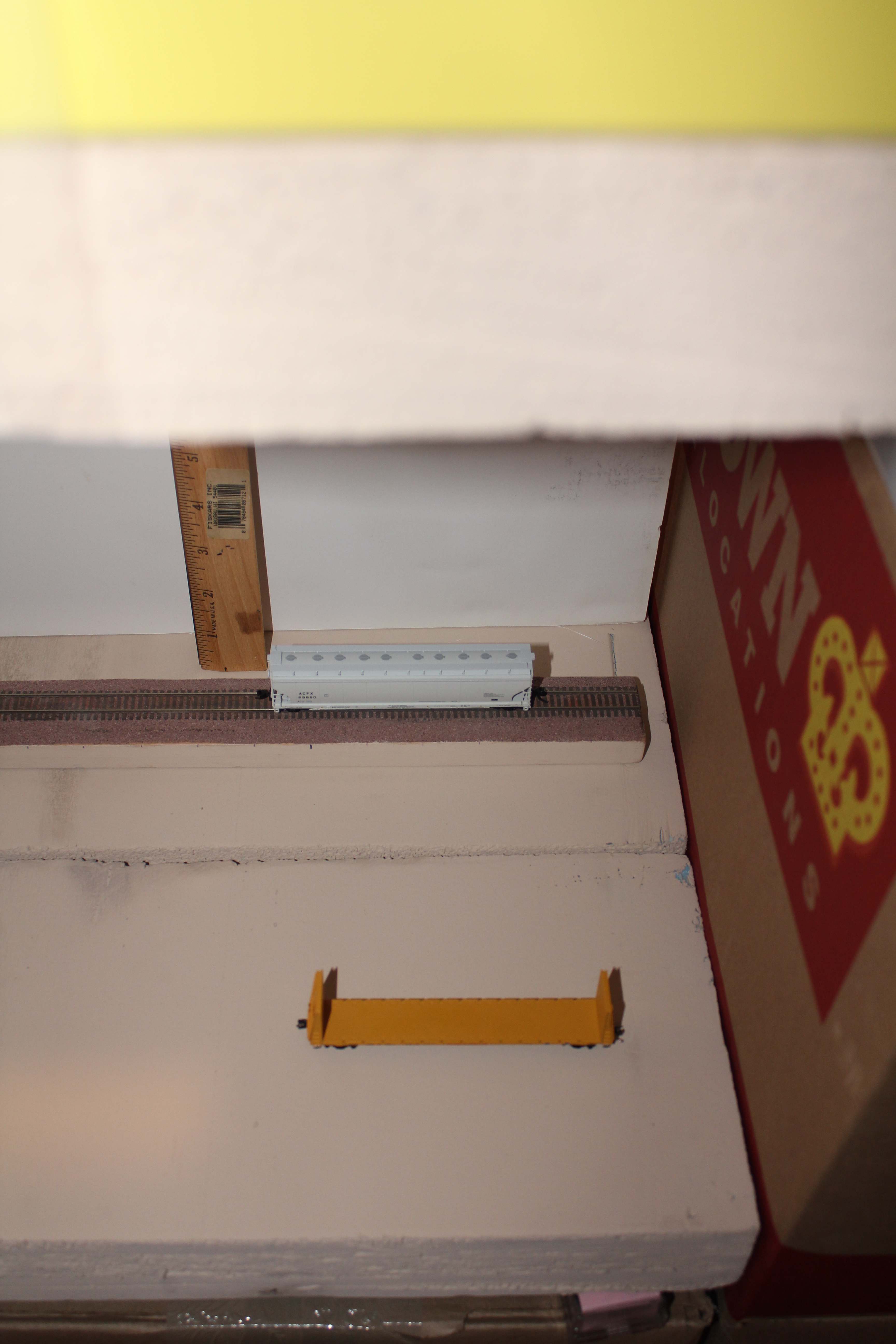
The mockups provided good validation of the numbers I got from the excel model. I had good visibility of the lower deck, good visibility of a portion of the lower backdrop, lower deck cars at a comfortable height for switching and good visibility and comfort working trains on the upper deck.
43” is a bit lower than I was expecting for the lower deck, but I’d have to raise both decks to bring up the lower deck height. That would make the upper deck too high. Compromises, what are you gonna do!
The lower deck gradually rises as the track goes from Richmond Terminal around the lower deck to the helix, As the deck rises, it becomes narrower in the plan. So 43 inches as a nominal height will work fine, I think and in places where the separation is less, I’ll be exploiting the advantages of very narrow decks.
Final Deck Numbers
After working through the details, I’ve ended up is the following dimensions and heights:
- Upper Deck Height: 60”
- Lower Deck Height: 43”
- Upper Deck Thickness: Not more than 3” thick at the facia.
- Maximum Deck Width: 14”, typical less than 12” is better
- Overhang: 0” or less. Where the lower deck is wider than 12”, ensure the upper deck underhangs the lower deck by at least an inch or two.
With the above numbers, there will be 14” of clear space between the lower deck and the underside of the upper deck.
In places where the upper deck is narrower than the lower deck, the two decks can be closer together, but my track arrangements don’t work like this all the way around the layout.
I also assume that the underside of the upper deck can taper away from the fascia, and the upper deck can be thicker towards the backdrop. Not sure if I’ll need to do this, but it will help in places where it is needed.
What do you think?
Okay, I have my heights for construction. What’s been your experience with deck heights? How easy was it to see and operate trains on each deck? What’s the best deck-to-deck separation?
Post a comment with your best set of numbers for these key dimensions:
- Typical operator height?
- Upper deck height?
- Lower deck height?
- Upper deck thickness at the fascia?
- Maximum deck width?
- Others?
Let me know.
Thanks for visiting.
Coxy
Next up: Adjustable, rolling legs.
